PRP is well established and legal almost everywhere. Exosome therapy shows promise but has thin evidence and no MHRA licence for hair loss in the UK. Here's how they actually compare, what a 2024 study found, and what's realistic to book.
PRP is well established and legal almost everywhere. Exosome therapy shows promise but has thin evidence and no MHRA licence for hair loss in the UK. Here's how they actually compare, what a 2024 study found, and what's realistic to book.
If you've spent any time down the hair-loss-treatment rabbit hole, you've probably come across both of these. PRP has been around for years and shows up on most hair clinics' price lists. Exosome therapy is the newer name that keeps popping up on forums and Instagram, usually with someone claiming it's the "next-generation" version of PRP.
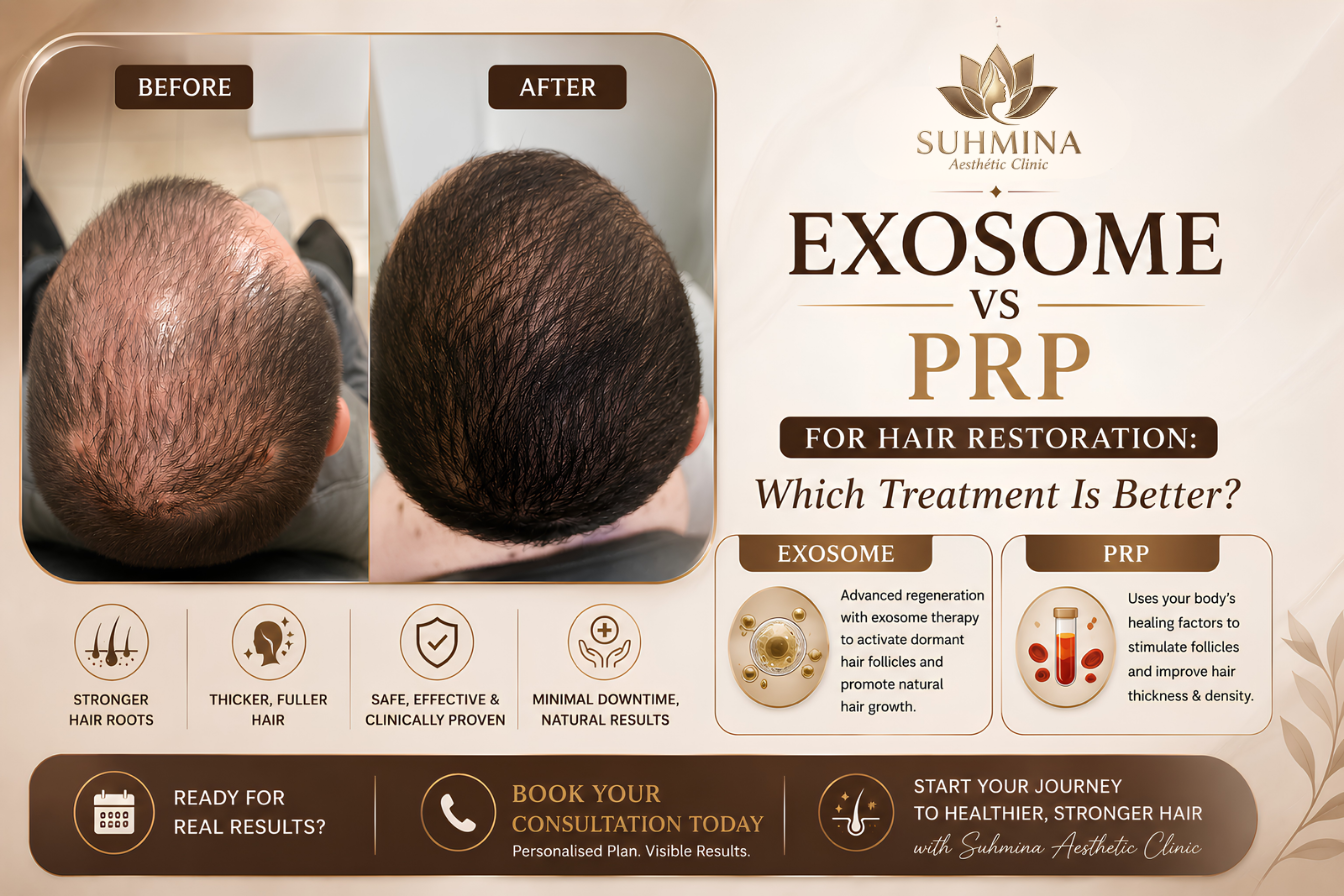
Here's the honest version, because most articles comparing the two skip the part that actually matters most: PRP is your own blood, spun down and put back into your scalp — well established, well studied, and legal pretty much everywhere. Exosome therapy uses lab-processed material from an outside source, and while the early results are genuinely interesting, the research behind it is thin, and in the UK, injecting it for hair loss isn't currently something a regular clinic can legally offer outside of a trial. That second part rarely makes it into the marketing — but it's exactly the kind of thing we get asked about by clients here at Suhmina in Aldershot, so it's worth laying out properly.
The short version, if you're in a hurry
PRP works by concentrating the platelets from your own blood and injecting them into the scalp, where they release growth factors that seem to help follicles stay in their active growth phase longer. It usually takes a handful of sessions — most protocols call for somewhere between three and six — plus occasional top-ups.
Exosome therapy skips the blood draw. Instead, you're getting tiny signalling vesicles that were grown and processed in a lab, usually from stem cells sourced elsewhere. The pitch is that these vesicles "talk" to your follicle cells more directly, and some clinics claim you need far fewer sessions to get there. That claim is based on very early, very small studies, not on the kind of large trial that would actually settle it.
And then there's the regulatory piece. Because PRP comes from your own body with minimal processing, UK regulators treat it more like a standard cosmetic procedure. Exosome products, because they're manufactured and sourced from someone else, get treated much more like a drug — and as of 2026, no exosome product has an MHRA marketing authorisation in the UK for hair loss. That doesn't mean nobody's offering it. It means that where it's offered outside of a proper clinical trial, it's sitting in a legal grey area at best.
What PRP actually is
A clinician draws a small amount of your blood — typically somewhere between 10 and 60ml, similar to a routine blood test — and spins it in a centrifuge. Most protocols use two spins: a gentler first spin to separate plasma from red blood cells, then a second, harder spin that concentrates the platelets into a much smaller volume. That process typically raises the platelet concentration to two to six times its normal level in blood, all packed with growth factors that support tissue repair.
Platelets are packed with those growth factors — commonly cited figures put the number of distinct growth factors and cytokines in PRP somewhere in the 7-to-25 range — and the theory, backed by a reasonable amount of clinical evidence at this point, is that delivering a concentrated dose of them directly to the follicles helps extend the hair's active growth phase and improves blood flow to the root.
Sessions run about 45 minutes to an hour, including the blood draw and spin time. Most people go through an initial course of three to six treatments spaced a few weeks apart, then move to periodic maintenance after that. Downtime is minimal — you might see some redness or mild tenderness for a day or two, but most people are back to normal life the same day.
What exosome therapy actually is
Exosomes are naturally occurring vesicles — tiny enough to be measured in nanometres, generally somewhere between 30 and 150nm — that cells release to communicate with each other. They carry proteins, microRNA, messenger RNA, and other signalling molecules. Where PRP delivers a relatively narrow set of platelet growth factors, exosome preparations are often described as carrying a much broader molecular cargo, sometimes cited in the hundreds of distinct bioactive molecules, because they're capturing more of a cell's full signalling profile rather than just what platelets release.
In hair restoration, the idea is to deliver a concentrated dose of these vesicles to the scalp, usually derived from cultured stem cells rather than drawn from your own body, to try to wake up dormant follicle stem cells, calm down inflammation, and generally make the scalp environment more favourable for growth.
Sessions look similar to PRP on the surface — under an hour, minimal downtime, mild redness at most, and no blood draw involved. The difference is in the sourcing: because the material comes from an external, manufactured source rather than your own blood, it's regulated more like a biologic drug, and that's really the crux of everything below.
How they actually compare
| PRP | Exosome Therapy | |
|---|---|---|
| Where it comes from | Your own blood | Lab-processed, usually from cultured stem cells |
| How it works | Growth factors from platelets (~7–25 identified factors) | Signalling vesicles carrying a broader molecular cargo (proteins, microRNA, growth factors) |
| Sessions, typically | 3–6, plus maintenance | Sometimes fewer per protocol, still not standardized |
| Evidence behind it | Years of clinical studies | Mostly small, early-stage case reports |
| Legal status in the UK | Generally permitted | No MHRA-licensed product for hair loss; injectable use is trial-only |
| Cost | Usually lower per session | Usually higher per session |
What the research actually shows
There's a small 2024 case series (Hassan et al., published in Dermis) that gets brought up a lot in exosome discussions, and it's worth talking through honestly because it's often quoted as if it settles the question. Five patients total. Two women, averaging 43 years old, got exosome therapy. Three men, averaging 29, got PRP. The exosome patients hit a solid improvement after a single session, and that improvement held up when they were checked again seven and twenty-eight months later. The PRP patients needed five to six sessions spread over six to sixteen months to get to a similar place.
That's a genuinely interesting result — matching multi-session PRP outcomes in one visit would be a big deal if it held up in a larger study. But five patients isn't a study you can build conclusions on, and the two groups weren't remotely comparable: different ages, different sexes, and quite possibly different types of hair loss altogether, since male and female pattern hair loss don't always behave the same way. Even the people discussing this study online were quick to point out the obvious limitations, and the study's own authors said as much too — this is a pilot that raises a hypothesis worth testing properly, not proof that exosomes beat PRP.
The regulatory reality, because it actually matters
This is the part most "PRP vs exosome" articles leave out entirely, and it's arguably more important than the biology.
In the UK, PRP is generally fine as an autologous procedure. Injectable exosome products, though, have no MHRA marketing authorisation for hair loss, and the only lawful way to access them right now is through an authorised clinical trial with proper ethics approval. Any facility handling the human-derived cells involved also needs a Human Tissue Authority licence. UK safety bodies have specifically called out clinics offering injectable exosomes outside this framework as a real concern — not a technicality, an actual patient-safety issue.
None of this means exosome therapy is a scam or that the science is fake. It means that if a clinic is offering it for hair loss and can't point to a specific, legitimate pathway — a trial, a licensed product, documented compliant sourcing — that's worth asking about before you book, not something to gloss over. It's also exactly why, at Suhmina, we're upfront about which regenerative treatments we can offer lawfully in the UK today and which are still confined to research settings.
What it'll cost you
Pricing varies a lot by clinic, but the general pattern holds pretty consistently: PRP costs less per session but usually needs more of them, while exosome therapy costs more per session with the promise — not yet proven at scale — of needing fewer visits overall. Given the UK regulatory position above, that trade-off is largely academic for exosome therapy right now, since routine access outside a clinical trial isn't currently available here. Ask any clinic for a full-course PRP estimate rather than just the per-session price.
So which one's right for you?
If you're dealing with early or moderate thinning and your follicles are still active, PRP is the safer bet — not just biologically, but in terms of having an actual track record and being something you can access without wading into a legal grey zone. It's a good fit if you're comfortable committing to a few sessions over a few months.
Exosome therapy only really makes sense right now if you can access it through a legitimate route — a proper clinical trial being the main one. If a clinic is offering it as a routine cosmetic add-on with no clear regulatory basis, that's a red flag worth taking seriously, however good the before-and-after photos look.
And worth saying plainly: neither of these replaces minoxidil, finasteride, or a hair transplant if your hair loss is more advanced. They're both best thought of as support for follicles that are still doing some of the work themselves, not a fix for follicles that have already gone dormant for good.
Thinking about PRP for hair loss in Aldershot?
At Suhmina Aesthetic Clinic we offer PRP hair restoration under a full in-person consultation, so you know exactly what you're having and why, before you commit to a course of treatment.
Call: 01483 906571 or 07873 728481 · Visit us: 103 High St, Aldershot GU11 1BY, United Kingdom
Ready to Book Your Consultation?
Schedule a personalized consultation with our experts and discover the best treatment plan for your unique skin goals.