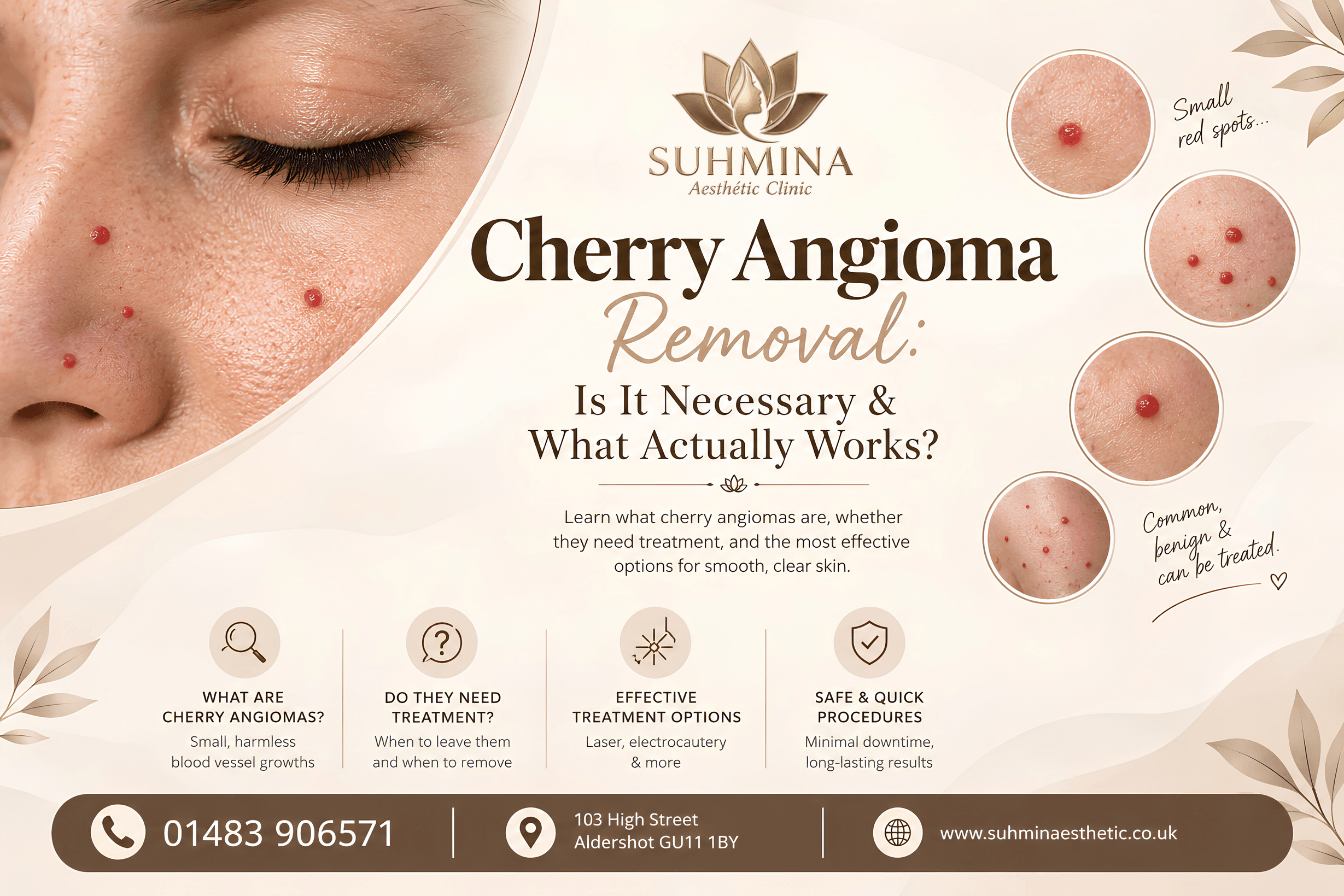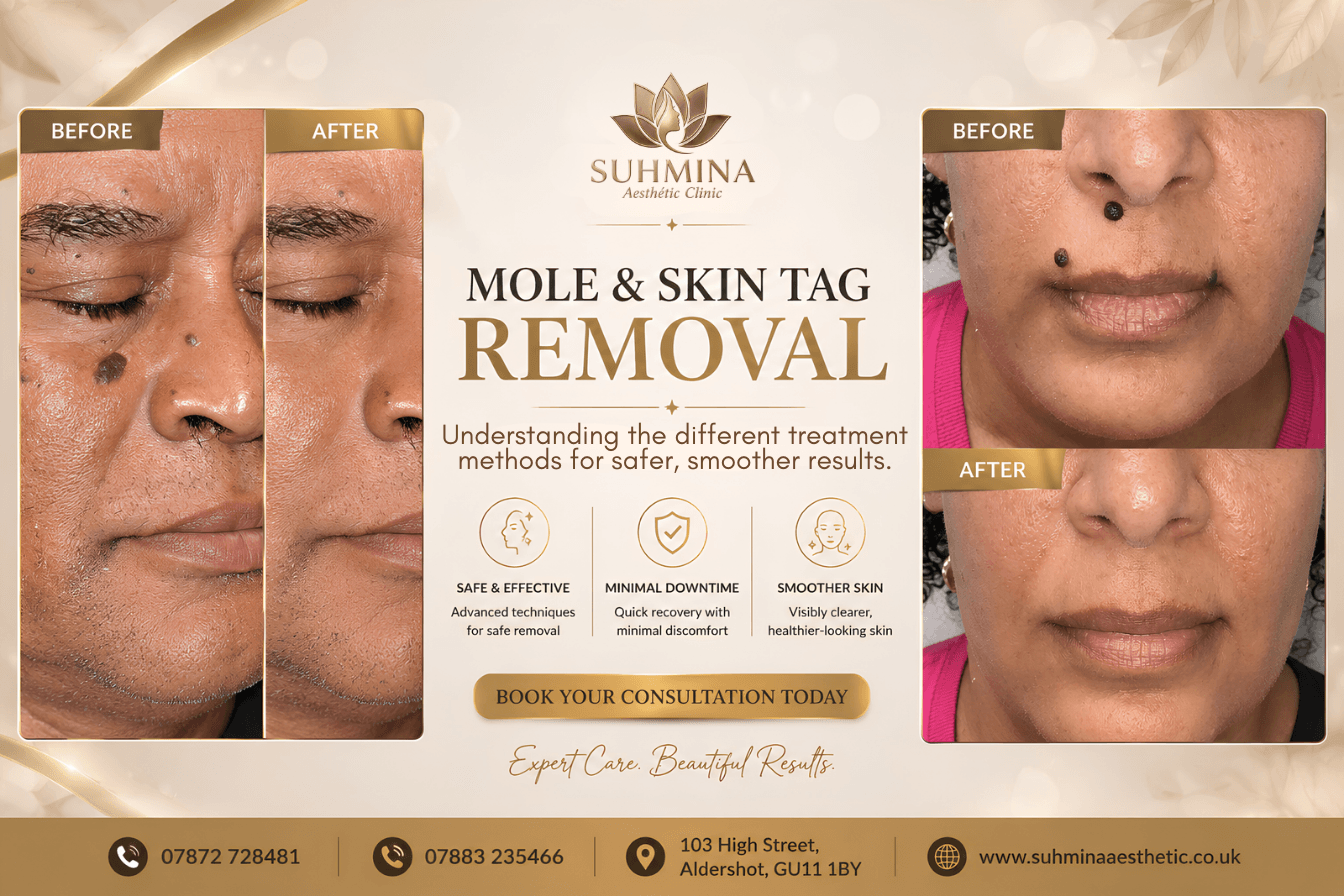
Thinking about getting a mole or skin tag removed? Here's what's actually worth knowing first — including when to see your GP, and what treatment options are available near you in Hampshire.
If you've been putting off dealing with a mole or skin tag, you're probably not alone. Most people who come to see us about one have had it for years — it's only when it starts catching on a necklace, or you're finally sick of it showing up in every photo, that booking an appointment moves up the list.
A quick reality check first: the NHS will usually only remove a mole or skin tag if there's a medical reason to. If it's purely cosmetic, you're looking at a private clinic — which is where we come in. We see clients from right across Hampshire, not just Aldershot itself — Farnborough, Fleet, Basingstoke, Winchester, Southampton, Portsmouth, Andover, Eastleigh, Fareham, Havant, Gosport and Alton all send us regulars, along with plenty of the smaller towns in between.
Moles vs skin tags — what's the difference?
A mole is a cluster of pigment cells that shows up as a flat or slightly raised spot, usually brown or black. Most of us have a handful somewhere on our skin, and almost all of them are completely harmless.
A skin tag is a small, soft flap of skin — the kind that tends to appear on the neck, under the arms, on the eyelids, or anywhere skin rubs against skin or clothing. They're usually linked to friction, hormones or age, and while they're not dangerous, they can be a nuisance.
Please don't try to remove one yourself
We get it — a skin tag and a pair of nail clippers looks like a five-minute fix, and there's no shortage of stories online of people who've done exactly that. The trouble is it's not always as simple as it looks. Removing a lesion yourself can lead to infection, bleeding that's hard to stop, or scarring you didn't bargain for. And every so often, something that looks like a harmless skin tag or mole turns out to need a proper look from a doctor — something a DIY method will never catch.
If it's anywhere near your eye, that goes double. Please leave those to a professional.
When to see your GP instead of booking with us
Before booking a cosmetic removal, it's worth running through the ABCDE checklist dermatologists use to flag moles that need a proper look first:
- Asymmetry — one half doesn't match the other
- Border — the edges are blurred, ragged or uneven
- Colour — more than one shade, or an uneven tone
- Diameter — bigger than about 6mm, roughly a pencil eraser
- Evolving — changing in size or shape, or starting to itch or bleed
If a mole ticks any of those boxes, or just looks different from the others, see your GP before anything else. Once it's been checked and confirmed benign, removing it for cosmetic reasons is entirely your call.
How we remove moles and skin tags
We choose the method based on the size, depth and location of what we're treating:
- Cryotherapy — freezing the lesion with liquid nitrogen. It blisters, scabs, and drops off naturally within one to three weeks. Quick, and usually the least fuss for smaller skin tags.
- Cauterisation — a fine heated probe removes the lesion and seals the area as it goes, which works well on thicker or raised spots.
- Ligation — for skin tags with a narrow base, a small band cuts off the blood supply and the tag falls away over a few days.
- Surgical excision — for larger moles, or if a sample needs sending off for testing, this gives the cleanest result with minimal scarring.
Every appointment starts with a proper look and a chat about what suits you best — we won't just pick a method and go.
What to expect, and healing afterwards
Most appointments are quick, with a local anaesthetic or numbing cream used where needed, so there's very little discomfort — more of a cold sensation or a small pinch than anything painful. You can generally get on with your day afterwards.
Healing depends on the method: cryotherapy sites usually blister and flake off within one to three weeks, while cauterised or excised areas form a small scab that clears up within a couple of weeks. Keep the area clean, try not to pick at it, and use SPF once it's healed, especially on the face.
Common questions
Q. Will the NHS remove it for free?
Ans. Only if there's a medical reason — a changing mole, or a skin tag that's bleeding or affecting your eyesight, for example. Cosmetic removal isn't funded and is done privately.
Q. Is it safe to do at home?
Ans. No — infection, bleeding and scarring are real risks, and there's no way to be sure a lesion is harmless without a professional looking at it first.
Q. Does it hurt?
Ans. Not really. Most people describe a brief cold feeling or a small pinch rather than pain.
Q. Will there be a scar?
Ans. It depends on the size, location and method, but smaller lesions treated with cryotherapy or cautery usually heal with little to no visible mark.
Q. How long until it's healed?
Ans. Anywhere from one to three weeks, depending on the method used.
Q. How much does it cost?
Ans. It depends on the size, number and type of lesion. Get in touch and we'll give you a proper quote after a quick consultation.
Do I need to be based in Aldershot to book?
Ans.Not at all. We regularly treat clients travelling in from across Hampshire — Farnborough, Fleet, Basingstoke, Winchester, Southampton, Portsmouth, Andover, Eastleigh and beyond.
More from Suhmina
While you're here, you might also want to look at some of our other skin treatments:
- Scar Treatment
- Advanced Skin Brightening Treatment
- Advanced Pigmentation & Brightening
- Clinical Acne Treatment
- Microneedling
- Chemical Peel Deep
- Laser Hair Removal
- Tattoo Removal
- Dark Circles Under Eye Treatment
- Dermal Filler
- Hair Restoration
Or see our full treatment list for everything we offer.
And if you're not sure whether a mole needs a GP check first, the NHS guide to moles is worth a read before you book.
Ready to sort it?
If there's a mole or skin tag that's been bothering you for a while, don't just keep putting it off. Come and see us — we'll have a proper look, talk you through what we'd recommend and why, and if you're happy to go ahead, we can usually sort it there and then. No pressure, no upselling, just an honest conversation about what's right for your skin.
Get in touch to book a consultation at our clinic on the High Street in Aldershot — wherever in Hampshire you're travelling from, we'd love to see you.
Ready to Book Your Consultation?
Schedule a personalized consultation with our experts and discover the best treatment plan for your unique skin goals.