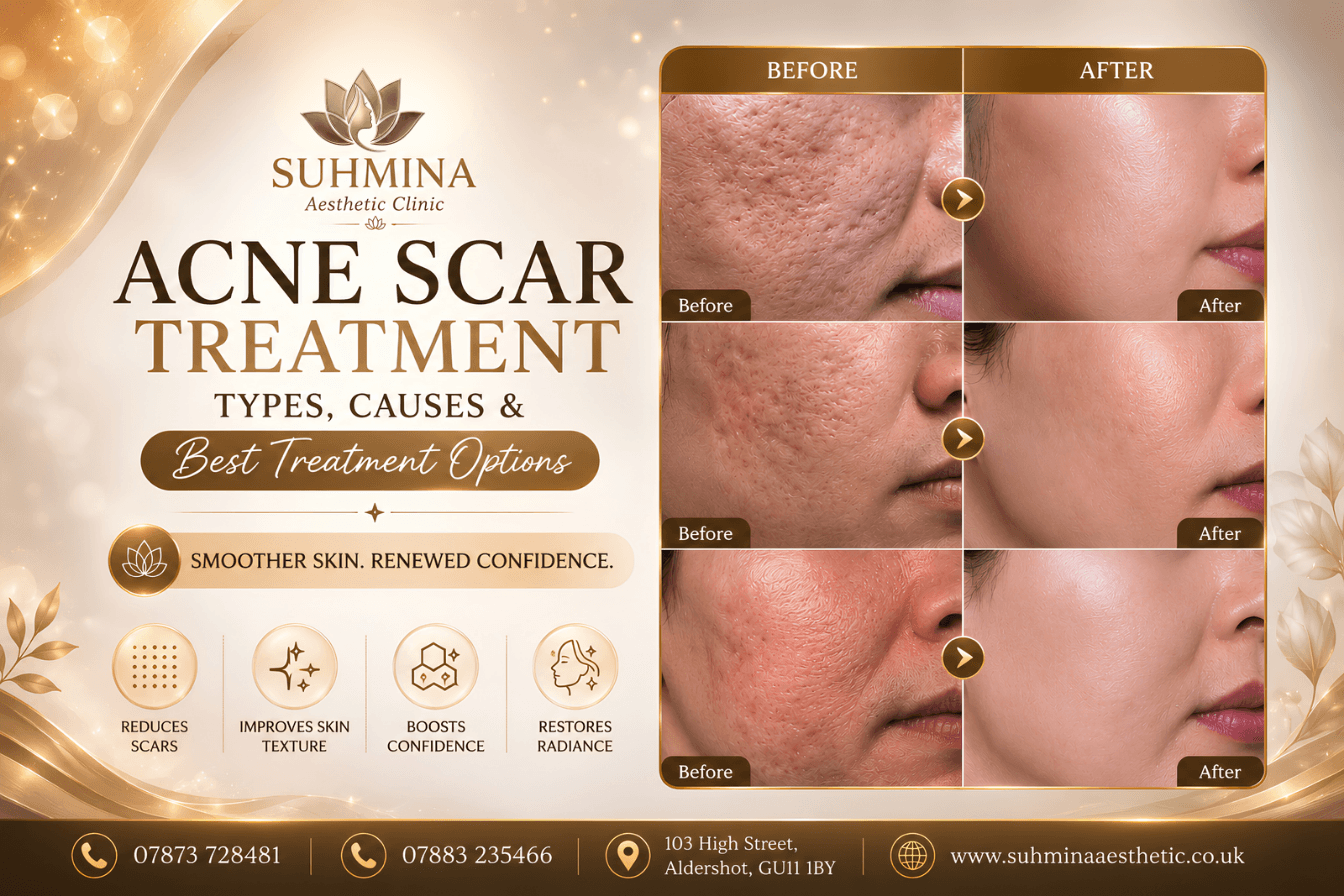
Ice pick, boxcar and rolling acne scars all respond differently to treatment. Here's what causes each type, and how our nurse-led team in Aldershot combines RF microneedling, subcision and skin boosters to treat them.
Quick answer: Acne scars form when the skin's healing response either destroys collagen (leaving pitted, indented scars) or overproduces it (leaving raised scars). There is no single "best" treatment — the right approach depends on your scar type, skin tone and goals. At Suhmina Aesthetic Clinic in Aldershot, we combine RF microneedling, subcision and skin boosters to target textural damage at different depths, with sessions starting from £199.
Why Acne Leaves Scars in the First Place
Not every breakout leaves a mark. Whether a spot heals cleanly or turns into a lasting scar comes down to how deep the inflammation went and how your individual skin responds while repairing itself.
When a blemish is inflamed — particularly cysts and nodules, which sit deeper in the skin than whiteheads or blackheads — the wall of the pore can break down. If the resulting damage spills into the surrounding tissue, the skin's repair process kicks in and starts laying down new collagen to close the wound.
The scar you're left with depends on how that repair goes: too little collagen in the repaired area creates a dip or indentation (an atrophic scar), while too much collagen creates a raised, thickened mark (a hypertrophic or keloid scar).
Genetics play a real role here too, which is why two people with similarly severe acne can end up with very different scarring.
The Main Types of Acne Scars
Most people who scar don't have just one type — it's common to see a mix across the face. Recognising which ones you have matters because each responds better to different techniques.
- Ice pick: Narrow, deep, pinpoint-like pits — the hardest atrophic scars to fully soften. Typically found on the forehead and upper cheeks.
- Boxcar: Broader indentations with sharply defined edges, like small craters. Common on the lower cheeks and jawline.
- Rolling: Shallow, wave-like depressions with sloping edges that make skin look uneven. Found on the lower cheeks and jaw.
- Hypertrophic / keloid: Raised, firm tissue that sits above the skin's surface, sometimes itchy or tender. Typically on the chest, back, shoulders and jawline.
Can Acne Scars Be Fully Removed?
Honestly — not always completely, but they can usually be visibly and significantly improved. Modern combination treatments can soften ice pick and boxcar scars, smooth out rolling scars, and flatten raised scarring considerably. Results build gradually across a course of sessions rather than disappearing after one visit, and outcomes vary depending on scar depth, skin type and how consistently a treatment plan is followed.
Treatment Options: What's Actually Available
Broadly speaking, acne scar treatments fall into a few categories.
Resurfacing approaches work on the skin's surface layer — chemical peels and laser resurfacing encourage smoother new skin to grow in over old scar tissue.
Collagen-stimulating approaches work underneath the surface — microneedling and radiofrequency (RF) microneedling create controlled micro-injuries that trigger the body to rebuild collagen, gradually filling in depressed scars from below.
Structural approaches physically release or fill the scar — subcision uses a fine needle to break the fibrous bands tethering a rolling or boxcar scar down, letting the skin surface lift back into place, while dermal fillers or skin boosters can add volume directly under a depressed scar.
Targeted approaches for raised scars — steroid injections are typically used to soften and flatten hypertrophic or keloid tissue.
Most people see the best results from combining two or three of these approaches rather than relying on just one, since ice pick, boxcar and rolling scars often sit at different depths on the same face.
Our Approach at Suhmina Aesthetic Clinic
At our Aldershot scar treatment clinic, treatment is built around combining three complementary techniques rather than a single generic protocol:
- RF Microneedling (£249) — combines fine needling with radiofrequency energy to stimulate deeper collagen remodelling, particularly effective on boxcar and rolling scars.
- Microneedling (£199) — a gentler collagen-stimulating option well suited to broader textural improvement and post-inflammatory marks.
- Skin Boosters (£199) — hydrating, collagen-stimulating injectables that add support beneath depressed scarring.
- Subcision — used where scars are tethered down by fibrous bands, to release the skin and let it settle back to a smoother surface.
Full pricing and session details are on our Scar Treatment service page.
Sessions run 45–90 minutes, and every plan starts with a free consultation where our Level 7 qualified, nurse-led team maps your specific scar pattern before recommending a combination — because a face with mostly rolling scars needs a different plan to one with predominantly ice pick scarring.
What to Expect From a Course of Treatment
Because scar tissue is stubborn by nature, meaningful improvement is a gradual process.
- Consultation & mapping — your practitioner assesses scar type, depth and skin tone to build a tailored plan.
- Active treatment phase — sessions are typically spaced a few weeks apart to allow collagen remodelling between visits.
- Collagen continues building for months — visible improvement often continues for up to 6 months after your last session, as new collagen matures.
- Maintenance — some people return periodically for a top-up session, particularly for deeper scarring.
Ready to Book Your Consultation?
Schedule a personalized consultation with our experts and discover the best treatment plan for your unique skin goals.