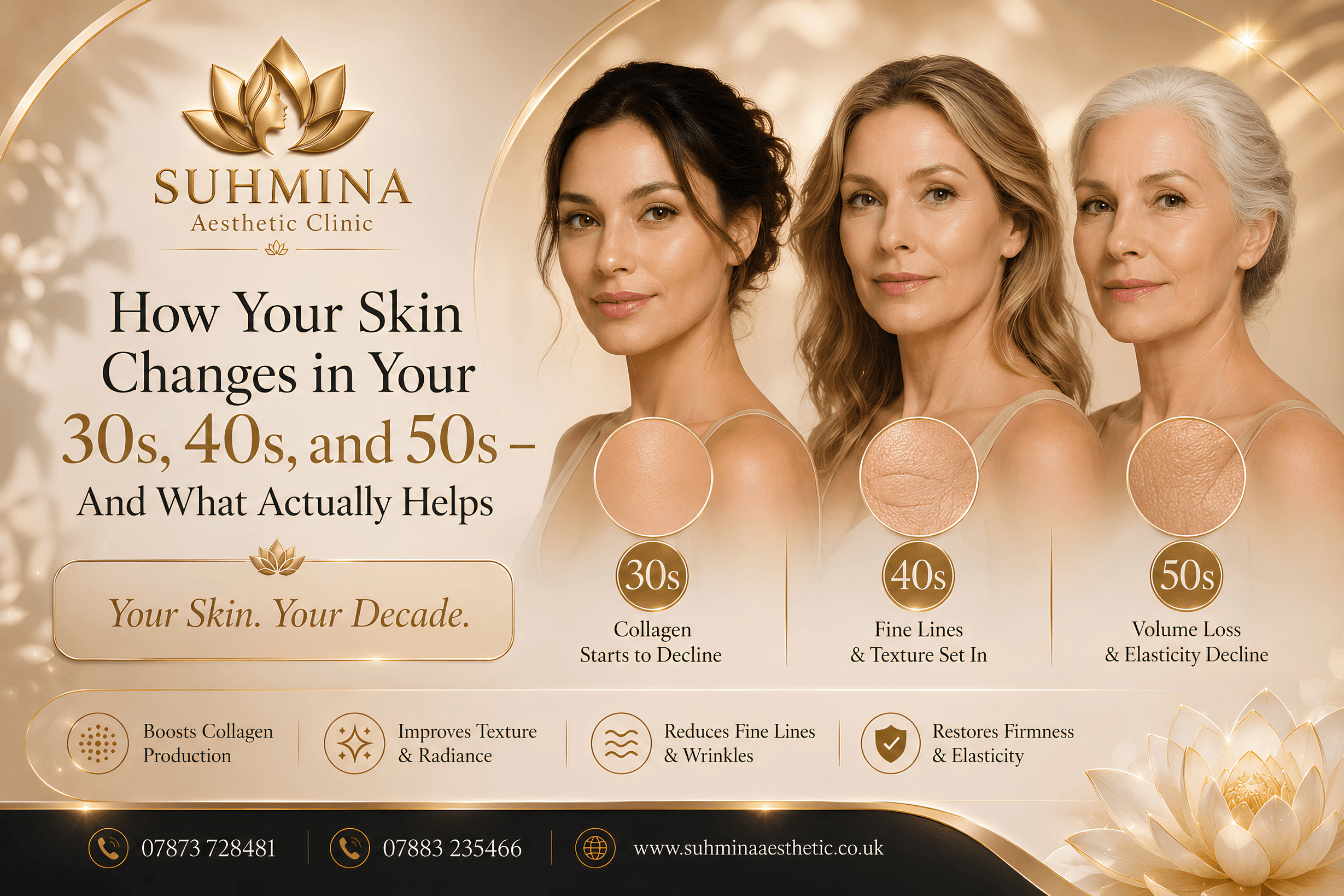
The way skin ages isn't one single process — it's several different things happening at once, at different rates, in different decades. Understanding this changes everything about how you approach your skin.
Skin ageing tends to get treated as though it's one thing. It isn't. It's a collection of overlapping biological processes: collagen loss, volume depletion, changes in skin texture, shifting fat pads, and bone remodelling. These happen at different rates across different decades of your life.
Understanding which processes are most active during each decade helps explain why certain treatments make sense at certain ages. It's also why the right approach to your skin at 35 looks quite different from what's appropriate at 50.
Your 30s: Prevention and Early Maintenance
The thirties are when most people first notice that their skin doesn't quite bounce back the way it used to. Fine lines appear after a late night and don't entirely disappear. A little volume loss begins around the temples and under the eyes. The radiance that came easily in your twenties requires more effort to maintain.
What's happening biologically is that collagen production begins to decline — by roughly 1% per year from your mid-20s. The skin's natural repair processes also slow slightly. Sun damage accumulated over the previous decade begins to become visible as uneven tone and early pigmentation.
In your 30s, the most impactful interventions are preventative and maintenance-focused. Medical-grade skincare containing vitamin C, retinoids, and SPF addresses pigmentation and collagen support. Skin boosters improve hydration and skin quality. Small, conservative doses of anti-wrinkle treatment prevent deep lines from setting in. The goal is maintenance, not correction — and this is often the most efficient time to invest in your skin.
Your 40s: Addressing Volume and Structural Change
The forties bring more noticeable change. Volume loss becomes more apparent — the cheeks flatten, the under-eye area hollows, the jawline softens. The fat pads that give youthful faces their structure begin to descend. Skin laxity increases as elastin production slows. Lines that were fine in your 30s become more established.
This is the decade where structural treatments become more relevant. Targeted filler placement can restore the volume that gives faces their shape. HIFU (High Intensity Focused Ultrasound) and radiofrequency treatments can address early laxity. Resurfacing treatments — chemical peels, laser, or microneedling — become increasingly important as skin texture and pigmentation concerns accumulate.
The forties also tend to be when patients benefit most from a treatment plan rather than individual appointments. That means thinking about which concerns to address in which order, and how treatments complement each other.
Your 50s and Beyond: Regeneration and Skin Health
The fifties bring the most significant structural changes, often accelerated by the hormonal shifts of menopause. Oestrogen decline has a profound effect on skin. Collagen and elastin production slow considerably, skin becomes drier and thinner, and volume loss becomes more pronounced. Many patients notice that their skin changes more visibly in the years around menopause than in any previous decade.
At this stage, regenerative treatments — polynucleotides, biostimulators, PRP — become increasingly relevant alongside structural support. The goal shifts from prevention to active regeneration: supporting the skin's own repair processes, restoring hydration at a deep level, and maintaining the structural integrity that naturally diminishes.
This is also the decade where a realistic, honest conversation about what non-surgical treatments can achieve becomes especially important. The right practitioner will help you understand what's genuinely possible. They'll also help you understand when surgical input might be worth considering, for concerns that non-surgical treatments can't adequately address.
At Any Age — Start With the Consultation
Whatever decade you're in, the most important step is a thorough consultation with a practitioner who understands how skin ages and how to approach it strategically. There's no universal treatment plan — what's right for you depends on your skin, your concerns, your history, and your goals.
At Suhmina Aesthetic Clinic in Aldershot, we take time at every consultation to understand exactly where you are with your skin and what would make the most meaningful difference. Book a consultation here — and let's build a plan that actually works for you.
Ready to Book Your Consultation?
Schedule a personalized consultation with our experts and discover the best treatment plan for your unique skin goals.